Have you ever heard someone say “it’s a local derby tonight” and wondered why a football match is being compared to a hat or a horse race? You’re not alone. The word derby shows up in so many different places — sports commentary, fashion catalogs, city rivalries, even roller-skating rinks — that it’s easy to get confused about what it actually means. 😅
Here’s the short answer: the Derby meaning depends entirely on context, but at its heart, the word almost always points to something big, competitive, and steeped in tradition. Whether it’s two rival teams from the same city clashing on the pitch, a prestigious horse race in Kentucky, or a stylish round hat, “derby” carries a sense of importance that has survived for centuries.
In this guide, we’ll dig deep into the real meaning of derby, trace its fascinating origin story, and walk through every major way the word is used today. By the end, you’ll never feel confused by a “derby” reference again. Let’s get into it!
What Is a Derby? The Simple Definition 📖
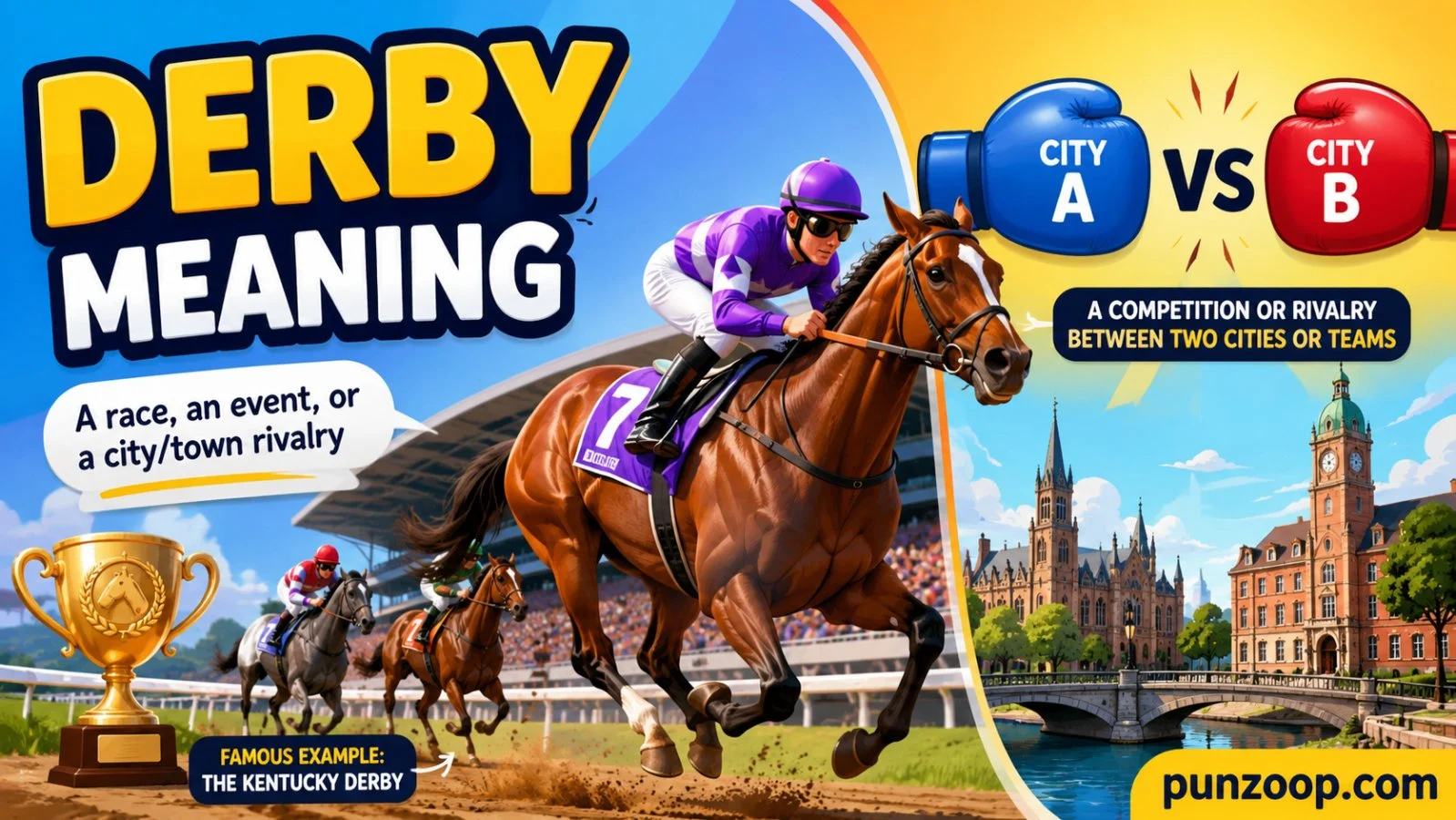
At its core, a derby is a competitive event or contest — usually one with a long history, strong rivalry, or high prestige. The word can function as a noun describing:
- A horse race, especially a famous annual one 🐴
- A sports match between two rival teams, often from the same city or region ⚽
- A stiff felt hat with a rounded crown and narrow brim, known as a “derby hat” or “bowler hat” 🎩
- A roller skating race or contact sport event, as in “roller derby” 🛼
- Loosely, any major competitive event in a given field
Dictionaries generally define derby as “a race or contest open to all comers” or “a sporting event, especially a match between two teams from the same area.” Both definitions capture the same underlying idea: competition wrapped in tradition and local pride.
“A derby isn’t just a game it’s history, pride, and bragging rights all rolled into ninety minutes.” a sentiment shared by football fans worldwide
The Origin of the Word “Derby” 🏛
To really understand the derby meaning, we need to travel back to 18th-century England. The word comes from a real place — Derby, a town in the East Midlands of England — and more specifically, from a person: Edward Smith-Stanley, the 12th Earl of Derby.
In 1780, the Earl of Derby helped establish a flat horse race for three-year-old fillies and colts at Epsom Downs in Surrey. As the story goes, the Earl and his friend Sir Charles Bunbury famously tossed a coin to decide whose name the race would carry. The Earl won, and the event became known as “The Derby.”
This single race, now called the Epsom Derby, became so iconic that its name eventually turned into a generic term. Any major, prestigious horse race around the world started borrowing the label “derby” — and from there, the word spread far beyond horse racing entirely.
How the Meaning Expanded Over Time ⏳
Language has a funny way of stretching a word’s meaning until it covers far more than its original use. Here’s roughly how “derby” evolved:
- 1780s: The Epsom Derby is founded in England — the original horse race.
- 1800s: “Derby” becomes a generic term for any big annual horse race (like the Kentucky Derby, founded in 1875).
- Late 1800s: The rounded felt hat, popularized around the same era, becomes nicknamed a “derby hat” in American English (called a “bowler hat” in Britain).
- 1900s onward: Sports journalists start using “derby” to describe intense local rivalry matches, especially in football (soccer).
- 1930s: “Roller derby” emerges in the United States as a competitive roller-skating event.
- Modern day: The word is used loosely for almost any high-stakes competitive event — demolition derby, chess derby, and beyond.
Isn’t it amazing how one coin toss between two English aristocrats ended up shaping vocabulary used across the entire planet? 🌍
Derby Meaning in Sports: Local Rivalry Matches ⚽🔥
If you follow football (soccer), basketball, or even cricket, you’ve probably heard commentators use “derby” constantly. In sports, a derby refers to a match between two teams that share a strong rivalry — usually because they’re from the same city, region, or have a historic feud.
These matches are famous for their intensity. Fans pack stadiums, tensions run high, and the result matters far more emotionally than a typical league fixture.
Famous Sports Derbies Around the World 🌐
| Derby Name | Teams Involved | Sport | Location |
| Manchester Derby | Manchester United vs Manchester City | Football | England |
| El Clásico | Real Madrid vs Barcelona | Football | Spain |
| Milan Derby (Derby della Madonnina) | AC Milan vs Inter Milan | Football | Italy |
| Old Firm Derby | Celtic vs Rangers | Football | Scotland |
| Merseyside Derby | Liverpool vs Everton | Football | England |
Notice something? El Clásico doesn’t technically use the word “derby” in its own nickname, but it’s often grouped under derby culture because of the fierce rivalry involved, even though Madrid and Barcelona aren’t in the same city. This shows how flexible the derby meaning has become in everyday sports talk.
Why Do Fans Care So Much About Derbies? ❤️🔥
There’s a simple reason derbies feel bigger than regular matches: identity. When two clubs from the same city face off, it’s not just about points on a table — it’s about neighborhood pride, family loyalty, and decades (sometimes centuries) of shared history. Losing to your local rival can sting far longer than losing to a distant, less familiar opponent.
Derby Meaning in Horse Racing 🐎🏆
Horse racing is where the word “derby” truly began, and it remains one of the most respected uses of the term today. A horse racing derby is typically an annual flat race for young horses (usually three-year-olds), and winning one is considered one of the highest honors in the sport.
The Kentucky Derby: America’s Most Famous Derby 🇺🇸
When most Americans hear “derby,” their minds jump straight to the Kentucky Derby. Held every year on the first Saturday in May at Churchill Downs in Louisville, Kentucky, this race is nicknamed “The Most Exciting Two Minutes in Sports.” It’s part of the prestigious Triple Crown of American horse racing, alongside the Preakness Stakes and the Belmont Stakes.
What makes the Kentucky Derby special isn’t just the race itself — it’s the entire experience: elegant hats, mint juleps, and a festival atmosphere that turns a two-minute sprint into an all-day cultural event. 🎩🥂
Other Notable Horse Racing Derbies 🐴
- Epsom Derby — the original, held in England since 1780
- Irish Derby — Ireland’s premier flat race
- Indian Derby — India’s most prestigious racing event, held in Mumbai
- Australian Derby — a major part of Sydney’s autumn racing calendar
This is a great example of how a single English tradition spread globally, with different countries creating their own version of “the derby” as the ultimate test for young racehorses.
Derby meaning: Where Fashion Meets Language 🎩
Here’s where things get interesting. In American English, “derby” doesn’t just refer to a race — it’s also the name for a specific style of hat. A derby hat is a stiff felt hat with a rounded (dome-shaped) crown and a narrow, curved brim.
In British English, this exact same hat is called a bowler hat. So why the different name in America?
Historians believe the hat earned its American nickname because it became closely associated with horse racing spectators, particularly at derby events, where well-dressed attendees would wear it as part of formal race-day attire. Over time, “derby” simply stuck as the popular American name for the hat style.
Quick Comparison: Derby Hat vs Bowler Hat
| Feature | Derby Hat (US) | Bowler Hat (UK) |
| Shape | Round, domed crown | Round, domed crown |
| Material | Stiff felt | Stiff felt |
| Common Region | United States | United Kingdom |
| Association | Horse races, formal wear | Business attire, historic British fashion |
So really, it’s the same hat with two different names — a small but fascinating detail that shows how one word can travel across the Atlantic and pick up an entirely new life. 🌊
Derby meaning:Roller Derby: A Completely Different Kind of Competition 🛼💥
Now let’s shift gears entirely. Roller derby is a fast-paced, physical contact sport played on roller skates, where two teams try to score points by lapping members of the opposing team on a track. It emerged in the United States in the 1930s and has since grown into a global sport, especially popular among women’s leagues.
Unlike horse racing or football, roller derby doesn’t involve rivalry between two established clubs from the same city (though local leagues do exist). Instead, the “derby” here simply signals a competitive racing-style event, echoing the word’s original racing roots.
Key Features of Roller Derby
- Played on a flat or banked oval track
- Two teams of skaters compete in timed periods called “jams”
- A designated “jammer” scores points by passing opposing skaters
- Known for its high energy, strategy, and physicality
This is a perfect example of how the derby meaning has stretched from “a specific horse race” to simply “any organized, competitive event,” especially one involving racing or contact.
Other Interesting Uses of the Word “Derby” 🎯
Once a word becomes popular enough, people start borrowing it for all kinds of unrelated events. Here are a few more places you might spot “derby” in everyday language:
- Demolition Derby — a motorsport event where drivers intentionally crash cars into each other until only one remains running 🚗💥
- Pinewood Derby — a popular Scouting event where kids race small wooden cars down a track 🪵
- Soap Box Derby — a gravity-powered car race, often for children, using homemade non-motorized vehicles
- Duck Derby — a charity fundraiser where rubber ducks race down a river 🦆
None of these have anything to do with horses, yet they all borrow the word “derby” because it instantly signals: this is a fun, competitive event with a bit of tradition behind it.
Derby meaning vs Classic vs Grand Prix: What’s the Difference? 🤔
People sometimes confuse “derby” with other competition-related terms like “classic” or “grand prix.” Here’s a quick breakdown to clear up the confusion:
| Term | Typical Meaning | Common Use |
| Derby | A prestigious race or rivalry match, often annual and tradition-based | Horse racing, sports rivalry, hats, roller sports |
| Classic | A long-standing, high-status race, often for a specific age group of horses | Horse racing (e.g., the “Classics” in British racing) |
| Grand Prix | A major race, typically in motorsport or show jumping | Formula 1, equestrian show jumping |
While all three terms describe prestigious competitive events, “derby” carries the strongest connection to rivalry and local pride, especially in sports culture.
How to Use “Derby” in a Sentence 📝
Understanding a word’s meaning is one thing — knowing how to actually use it is another. Here are a few natural example sentences:
- “The city shuts down every year for the annual derby at the racecourse.”
- “It’s a local derby this weekend, so expect the stadium to be completely sold out.”
- “He wore a smart derby hat to the wedding, and it looked fantastic.”
- “My daughter just joined a roller derby league and loves it.”
- “Their old truck barely survived the demolition derby.”
Notice how the meaning shifts completely depending on the noun that follows or the context surrounding it. That flexibility is exactly what makes “derby” such an interesting word to study. 🔍
Derby meaning in Pop Culture and Media 🎬
The word “derby” pops up constantly in movies, TV shows, and books — usually to signal excitement, tradition, or dramatic rivalry. Sports documentaries love to build entire episodes around “derby day,” showing fans in face paint, packed stands, and nail-biting finishes. Horse racing films often center around the emotional buildup to a derby win, portraying it as a life-changing moment for jockeys, trainers, and owners alike.
Even outside sports storytelling, the word has crept into casual slang. You might hear someone jokingly call an intense competition at work a “office derby,” simply to emphasize how seriously people are taking it. This kind of playful borrowing shows just how deeply the word has settled into everyday English.
Common Misconceptions About Derby Meaning ⚠️
Let’s clear up a few myths people often get wrong:
- Myth: “Derby” always refers to horse racing.
Truth: While that’s the origin, today it applies to sports rivalries, hats, roller sports, and more. - Myth: A “derby” match must always involve two teams from the exact same city.
Truth: While that’s the classic definition, some historic regional or national rivalries (like El Clásico) are often grouped into derby culture too. - Myth: “Derby hat” and “bowler hat” are different styles.
Truth: They’re the same hat — just different regional names.
Clearing up these small misunderstandings helps you use the word with confidence, whether you’re chatting about football, fashion, or racing.
Why Understanding Derby Meaning Matters 💡
You might be wondering: why does any of this matter beyond trivia? Well, understanding how a word like “derby” evolves gives you a small window into how language grows over time. A single event in 1780s England eventually shaped how millions of people talk about hats, horses, football rivalries, and even children’s toy car races nearly 250 years later.
It’s also genuinely useful. If you’re traveling, watching international sports, reading classic literature, or shopping for vintage fashion, you’ll run into “derby” in unexpected places. Knowing its full range of meanings means you’ll never be caught off guard.
FAQs:
1. What does “derby” mean in simple terms?
In simple terms, a derby is a major competitive event — usually a race or rivalry match — that carries a strong sense of tradition, prestige, or local pride.
2. Where does the word “derby” come from?
It comes from the 12th Earl of Derby, who helped found a famous horse race at Epsom Downs, England, in 1780. The race was named after him following a coin toss with a friend.
3. What is a “local derby” in football?
A local derby is a match between two rival teams from the same city or region, known for intense fan passion and historic rivalry, such as the Manchester Derby or Merseyside Derby.
4. Is a derby hat the same as a bowler hat?
Yes! A derby hat (American English) and a bowler hat (British English) refer to the exact same round, stiff felt hat — just with different regional names.
5. What is roller derby?
Roller derby is a competitive, physical sport played on roller skates, where two teams try to score points by strategically lapping opposing skaters on a track.
Conclusion:🏁
So, what’s the real derby meaning? As we’ve seen, there isn’t just one answer — and that’s exactly what makes the word so fascinating. From a single horse race in 18th-century England to fierce football rivalries, elegant hats, roller-skating sports, and even backyard car races, “derby” has grown into one of the most versatile words in the English language.
At its heart, every version of “derby” shares the same spirit: competition, tradition, and a bit of excitement that turns an ordinary day into something people remember and talk about for years.
Next time you hear someone mention a “derby,” you’ll know exactly what they’re talking about — and maybe even impress them with a bit of history behind it! 😄