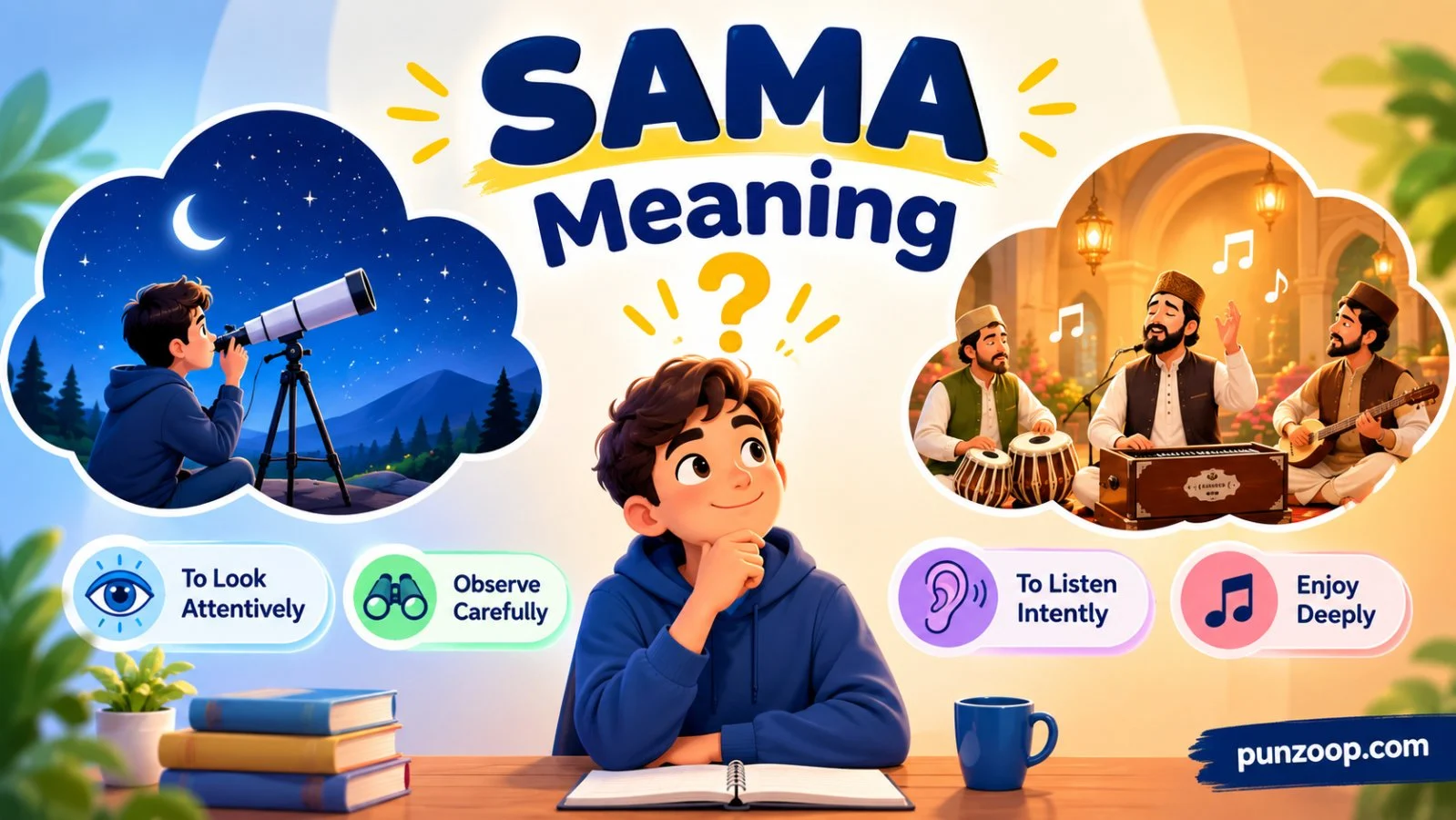
Sama meaning has a little mystery to it, but that’s part of its charm. Often associated with meanings like “sky,” “heaven,” or “elevated,” Sama is a graceful name with a bright, uplifting feel.
In this guide, we’ll explore the Sama name meaning, its origin, pronunciation, and the qualities commonly linked with it. Whether you’re choosing a baby name, curious about its cultural roots, or simply wondering what Sama means, you’ll find the key details in one easy read.
There’s plenty to uncover behind this beautiful name. So, let’s take a closer look at Sama and see what makes it so special.
What Is the Sama Meaning at a Glance? 🌟
Let’s start simple. In its most widely recognized form, the sama meaning comes from Arabic, where it translates to “sky” or “heaven.” It also carries a secondary meaning of “high status” or “a woman of elevated standing.” Beautiful, right? 🌌
But here’s where it gets interesting — the word doesn’t stop at Arabic borders. In Japanese, “sama” (様) functions completely differently. It’s an honorific suffix, similar to how English speakers use “Mr.” or “Madam,” but with a much deeper layer of respect attached to it.
And then there’s a third, often overlooked dimension: in Sufi Islamic tradition, “Sama” refers to a spiritual practice of listening, chanting, and whirling that’s meant to bring the soul closer to the divine. So really, the sama meaning depends entirely on the cultural lens you’re using.
“A name is the first poem anyone ever writes about you.” — and Sama proves this beautifully across three completely different cultures. ✨
The Arabic Origin of Sama: Sky, Status, and Serenity ☁️
Let’s dive deeper into where most people first encounter this word — Arabic. The root verb samā (سما) means “to rise,” “to be elevated,” or “to transcend.” From this root, we get the noun Sama, which is commonly translated as “sky” or “heaven.”
This isn’t a coincidence. In classical Arabic linguistics, words connected to height, elevation, and the heavens often share the same root family. That’s why you’ll notice similar names like Sami (meaning “elevated” or “sublime”) and Samiya or Samia (the feminine form) sitting right next to Sama in name dictionaries.
So when someone asks about the sama meaning in Arabic, the honest answer includes several layered interpretations:
- 🌤️ Sky — the literal and most common translation
- 👑 High status — someone respected, admired, or of noble character
- 💖 Beautiful woman — used poetically in some regional dialects
- 🕊️ Peaceful nature — a calm, serene personality
- 😊 Carefree and lively spirit — used in certain cultural contexts
What I personally find touching about this name is how it captures both grounded warmth and limitless aspiration in a single word. It’s a name that quite literally means “look up.”
Sama in Japanese Culture: A Mark of Deep Respect 🇯🇵
Now let’s shift continents entirely. If you’ve watched anime, read manga, or studied Japanese, you’ve probably heard “sama” attached to a character’s name — like “Okaa-sama” or “Ojou-sama.” So does this change the sama meaning completely? Yes, actually — and that’s what makes this word so fascinating.
In Japanese, “sama” (様) is an honorific suffix used to show heightened respect toward someone of higher status — royalty, judges, religious figures, customers in formal business settings, or even beloved characters in fiction. Think of it as a much more formal and reverent version of “san,” which is the everyday equivalent of “Mr.” or “Ms.”
Here’s a simple table to help you visualize how Japanese honorifics stack up in terms of formality:
| Honorific | Level of Respect | Typical Usage |
| -chan | Casual, affectionate | Close friends, children, pets |
| -kun | Informal, friendly | Male peers, juniors |
| -san | Standard polite | Everyday interactions |
| -sama | Very high respect | Royalty, deities, customers, elders |
So while the Arabic sama meaning points toward the sky and elevated status, the Japanese usage reflects that same idea of “elevation” — just expressed through social respect rather than a literal noun. Isn’t it remarkable how two completely unrelated language families both landed on the concept of “high” and “honored” with strikingly similar sounds? 🌏
Sama in Sufi Spiritual Practice: The Sound of the Soul 🕌
Here’s where the sama meaning takes on a much more mystical, almost sacred tone. In Sufi Islam, particularly within the Mevlevi order founded by followers of the poet Rumi, “Sama” refers to a ceremonial practice involving music, chanting, poetry, and the famous whirling dance performed by dervishes.
The word itself is often translated as “listening” or “audition” in this context — the idea being that practitioners “listen” with their whole body and soul, not just their ears, in order to achieve a state of spiritual ecstasy and closeness to the divine.
This ritual is deeply symbolic:
- 🌀 The spinning motion represents the movement of celestial bodies around the sun
- 🎵 The music and poetry are meant to awaken the heart, not just entertain
- 🤲 The raised right hand symbolizes receiving blessings from above
- 🌍 The lowered left hand symbolizes passing those blessings to the earth
When you connect this back to the Arabic root of “rising” and “the sky,” it all starts to click. The Sufi Sama ceremony is literally an act of physically and spiritually reaching upward — toward the heavens, toward transcendence, toward the same “sky” that gives the name its original meaning. 💫
Is Sama a Girl’s Name or Boy’s Name? 👧👦
This is one of the most commonly asked follow-up questions once people understand the basic sama meaning. In most modern usage, especially in Arabic-speaking countries and among diaspora communities, Sama is predominantly used as a girl’s name.
It’s also occasionally used as a surname in various cultures, and in rare cases, as a unisex name depending on regional customs. If you’re a parent exploring this name for your baby, here’s a quick breakdown:
| Aspect | Details |
| Primary gender usage | Girl’s name (most common) |
| Origin | Arabic, with Japanese and Sufi connections |
| Core meaning | Sky, heaven, high status |
| Popularity | Rising steadily in Western countries |
| Related names | Sami, Samia, Samiya, Sema |
Sama Name Popularity: Why It’s Rising Fast 📈
Something interesting has been happening over the last decade — the name Sama has been quietly climbing the popularity charts in several English-speaking countries. Parents today are drawn to names that are short, melodic, easy to pronounce across cultures, and carry genuine meaning rather than being trendy for no reason.
Here’s why so many families are choosing this name once they discover the sama meaning:
- 🎶 It’s short, soft, and easy to pronounce in almost any language
- 🌈 It works beautifully across multicultural or interfaith families
- 📜 It has a poetic, symbolic meaning tied to the sky and elevation
- 🕊️ It carries spiritual weight without being tied to one narrow interpretation
- 💫 It sounds modern while still feeling timeless
Spelling Variations and Related Names 🔤
Just like many names that cross linguistic borders, Sama has a few close cousins and spelling variations you’ll often see floating around baby name websites and cultural directories.
- Sema — the Turkish variation, closely tied to the Sufi whirling ceremony
- Samaa — an extended Arabic spelling emphasizing the elongated vowel sound
- Sami / Samee — the male form, meaning “elevated” or “sublime”
- Samia / Samiya — the feminine form derived from the same root
- Samar — a different but related name meaning “evening conversation,” sometimes confused with Sama
It’s worth noting that Samar and Sama, while they look and sound similar, actually stem from different root verbs in Arabic. Samar relates to nighttime conversation and storytelling, while Sama relates to height and the sky. Knowing this distinction helps clear up a lot of confusion people have when researching the sama meaning online.
Numerology and Symbolic Traits Associated With Sama 🔮
While numerology isn’t a science, many parents and name enthusiasts enjoy exploring the symbolic personality traits often associated with names. For Sama, common associations include:
- ✨ Ambition — reflecting the “reaching toward the sky” imagery
- 🕊️ Calmness — tied to the “peaceful nature” interpretation
- 👑 Confidence — connected to the “high status” meaning
- 🎨 Creativity — often linked to the spiritual and artistic Sufi Sama ceremony
- 💞 Warmth — the soft, gentle sound of the name itself
Of course, a name doesn’t determine personality — but it’s fun to see how the layered sama meaning continues to influence how people perceive the name emotionally, even today.
Sama in Pop Culture and Modern Usage 🎬
Beyond its linguistic and spiritual roots, “Sama” has also found its way into modern pop culture, documentaries, and media titles — often chosen specifically because of its emotional depth. The word has been used in film titles, brand names, and creative projects precisely because it evokes imagery of the sky, hope, and looking upward even during difficult times.
This dual nature — a word that’s both grounded in ancient tradition and completely at home in modern storytelling — is part of what makes the sama meaning so versatile and emotionally resonant for creators, parents, and spiritual seekers alike.
How to Pronounce Sama Correctly 🗣️
Pronunciation can vary slightly depending on the language of origin, but here’s a simple, friendly breakdown:
| Language | Pronunciation | Stress |
| Arabic | SAH-mah | Even stress on both syllables |
| Japanese | SAH-mah | Flat, even tone |
| English (Western) | SAH-mah or SAY-mah | Slight stress on first syllable |
No matter which pronunciation you choose, the softness of the name tends to remain consistent — which is likely another reason it travels so easily across cultures.
Common Misconceptions About the Sama Meaning ❌
Because this word appears in multiple unrelated languages, a lot of misinformation floats around online. Let’s clear up a few things:
- 🚫 Myth: Sama and Samar mean the exact same thing.
✅ Fact: They come from different Arabic root verbs with different meanings. - 🚫 Myth: The Japanese “sama” and Arabic “Sama” share a linguistic root.
✅ Fact: They’re completely unrelated languages; the similarity is a coincidence. - 🚫 Myth: Sufi Sama is just a “dance.”
✅ Fact: It’s a structured spiritual ceremony involving music, poetry, and prayer, not merely performance.
Understanding these distinctions gives you a much richer, more accurate picture of the true sama meaning instead of relying on surface-level guesses. Taking a few extra minutes to fact-check a name’s origin — rather than trusting the first result you see — is always worth it, especially for something as personal and lasting as a name.
Names With Similar Meaning to Sama Around the World 🌐
One of the most fascinating things about researching the sama meaning is realizing how many other cultures have their own version of a “sky name.” Humans everywhere seem drawn to naming their children after the heavens, and once you start comparing, you’ll notice a beautiful global pattern.
Here’s a quick look at names from different languages that share a similar spirit to Sama:
| Name | Language | Meaning |
| Sama | Arabic | Sky, heaven, high status |
| Sema | Turkish | Sky, heaven (Sufi origin) |
| Aria | Persian/Italian | Air, melody |
| Malak | Arabic | Angel |
| Skyler | Dutch/English | Scholar, sheltering (often linked to “sky” phonetically) |
| Uranai | Greek-inspired | Heavenly |
Notice how each of these names, in their own linguistic tradition, tries to capture the same feeling — vastness, hope, and something greater than ourselves. That’s exactly the emotional territory the sama meaning occupies in Arabic and Sufi contexts.
Real-Life Examples: How Families Use the Name Sama 👨👩👧
To really understand the sama meaning in action, it helps to look at how real families incorporate it into their lives. Many parents choose Sama as a first name specifically because of its clean, universal sound — it’s pronounced almost identically whether you’re speaking Arabic, English, Urdu, Turkish, or French.
Some common real-world patterns include:
- 👶 As a standalone first name — simple, elegant, and easy to spell on official documents
- 💍 As a middle name — often paired with a longer traditional name to add a touch of softness
- 🏠 As a family or business name — some households and small businesses use “Sama” to evoke openness and aspiration
- 📖 As a symbolic gift name — parents sometimes choose it after significant life events, like the birth of a child under a clear night sky, to honor that memory
This flexibility is a big part of why the sama meaning continues to resonate with people who want a name that’s both meaningful and easy to carry through life, across borders and languages.
Sama as a Word Beyond Names: Everyday and Cultural Usage 📚
It’s worth remembering that Sama isn’t only a personal name — it also exists as a standalone word in everyday Arabic vocabulary and appears in poetry, song lyrics, and religious texts referring to the sky or heavens. Because Arabic poetry has always leaned heavily on natural imagery, “sama” shows up frequently as a symbol of hope, distance, freedom, and divine presence.
In many Arabic proverbs and expressions, looking toward the “sama” is used metaphorically to describe someone who is hopeful, ambitious, or spiritually devoted. This everyday usage reinforces just how deeply rooted the sama meaning is in the broader culture — it isn’t just a name choice, it’s a piece of living language that people use daily without even thinking twice about its poetic weight.
Tips for Parents Considering Sama as a Baby Name 👶💭
If you’re seriously considering this name for your little one, here are a few friendly, practical tips to think through before making your final decision:
- 🔤 Check pronunciation across your family’s languages — make sure it flows naturally with your surname
- 📝 Consider spelling variations like Sama, Samaa, or Sema depending on your cultural background
- 🎁 Think about middle name pairings — short names like Sama often pair beautifully with longer, more traditional middle names
- 🌍 Reflect on the layered meaning — sky, status, respect, and spirituality — and decide which resonates most with your family’s values
- 💌 Ask family members for their reaction — since the name carries cultural and spiritual weight, it can be meaningful to share the story behind the sama meaning with grandparents or elders
Choosing a name is one of the most personal decisions a parent makes, and understanding the full sama meaning — not just a surface-level translation — can make that decision feel even more intentional and heartfelt.
Sama Across Different Regions: A Cultural Snapshot 🗺️
Because the sama meaning touches so many cultures, it’s worth taking a moment to appreciate how differently the name is received depending on where you are in the world. Context genuinely shapes perception, and Sama is a wonderful case study in that.
- 🕌 Middle East & North Africa: Sama is recognized instantly as an Arabic name tied to the sky and elevated status, often chosen for its poetic, gentle sound.
- 🌏 South Asia: Sama is increasingly popular among Muslim families, sometimes paired with a longer traditional name for balance.
- 🇹🇷 Turkey: The closely related “Sema” carries strong ties to Sufi heritage and the whirling dervish ceremony, making it feel spiritually significant.
- 🇯🇵 Japan: “Sama” isn’t typically used as a first name, but the honorific usage means the sound itself is instantly associated with respect and formality.
- 🌎 Western Countries: Sama is gaining traction as a multicultural, easy-to-pronounce name that still carries deep symbolic roots.
This regional variation is part of what makes exploring the sama meaning so rewarding — it’s rarely just about a dictionary definition. It’s about how a single word travels, adapts, and picks up new emotional layers as it moves from one culture to the next.
Sama Compared to Other Spiritually Rooted Names 🕯️
If you’re drawn to names with spiritual or symbolic depth, it helps to see how Sama stacks up against other popular choices with similar emotional resonance. Many parents comparing names want something that sounds gentle but still carries real substance behind it.
| Name | Core Theme | Feel |
| Sama | Sky, elevation, spiritual listening | Soft, airy, hopeful |
| Noor | Light | Bright, radiant |
| Amara | Eternal, unfading | Strong, timeless |
| Layla | Night | Mysterious, romantic |
| Zahra | Flower, radiance | Delicate, blooming |
What makes the sama meaning stand out among this group is its dual nature — it’s simultaneously about looking outward toward something vast (the sky) and looking inward toward something reflective (spiritual listening in the Sufi tradition). Very few names manage to hold both of those ideas at once so gracefully.
A Closer Look at the Etymology and Linguistic Roots 📜
For readers who love digging into word history, let’s slow down and really trace the linguistic path behind the sama meaning. Arabic is a root-based language, meaning most words are built from a three-letter core that carries the fundamental idea, with different patterns added to create nouns, verbs, and adjectives.
The root here is س-م-و (s-m-w), which broadly relates to height, elevation, and nobility. From this single root, Arabic branches out into an entire family of related words and names:
- 🔹 Samā — sky, heaven
- 🔹 Sāmī — elevated, sublime, high-minded
- 🔹 Sumuw — nobility, loftiness, highness (used formally, like “Your Highness”)
- 🔹 Samiya / Samia — the feminine adjective form, meaning “elevated one”
Understanding this root system helps explain why the sama meaning feels so consistent across all its related names — they’re not just similar by coincidence, they’re literally branches of the same linguistic tree. It’s a beautiful example of how language can encode an entire worldview into just a handful of letters.
Interestingly, this same root also appears in formal royal titles across the Arab world, where officials are addressed with phrases built from sumuw, meaning “highness.” So when a family chooses the name Sama for their daughter, they’re tapping into centuries of linguistic tradition tied to dignity, elevation, and quiet nobility — whether they realize it consciously or not.
FAQs: ❓
What does the name Sama mean in Arabic?
In Arabic, the sama meaning is primarily “sky” or “heaven,” with secondary meanings of “high status” and “peaceful nature.” It comes from the root verb samā, meaning “to rise” or “to be elevated.”
Is Sama a Muslim or Islamic name?
Yes, Sama is widely used among Muslim families, particularly because of its Arabic origin and its connection to the spiritual Sufi Sama ceremony, though it’s also used by non-Muslim Arabic-speaking families.
What does “sama” mean in anime or Japanese?
In Japanese, “sama” is an honorific suffix used to show deep respect, similar to “Mr.” or “Madam,” but far more formal. It’s often used for royalty, deities, or beloved characters in anime and manga.
Is Sama a common baby name?
Sama has been steadily growing in popularity, especially among multicultural families, thanks to its short length, gentle sound, and meaningful symbolism connected to the sky and elevated status.
What is the Sufi Sama ceremony?
The Sufi Sama is a spiritual practice involving music, poetry, and the famous whirling dance performed by Mevlevi dervishes, symbolizing the soul’s journey toward divine connection and transcendence.
Final Thoughts:
At its core, the sama meaning tells a story that spans continents, religions, and centuries — from the wide-open Arabic sky, to the formal bow of Japanese respect, to the spinning grace of a Sufi dervish reaching toward heaven. Few words carry this much emotional and cultural weight in just four letters.
Whether you’re considering this name for your child, researching it for personal or spiritual reasons, or simply curious after hearing it somewhere, one thing is clear: Sama is a name that means so much more than it first appears. It’s about looking upward, standing tall, and carrying yourself — and others — with quiet dignity. 🌤️