
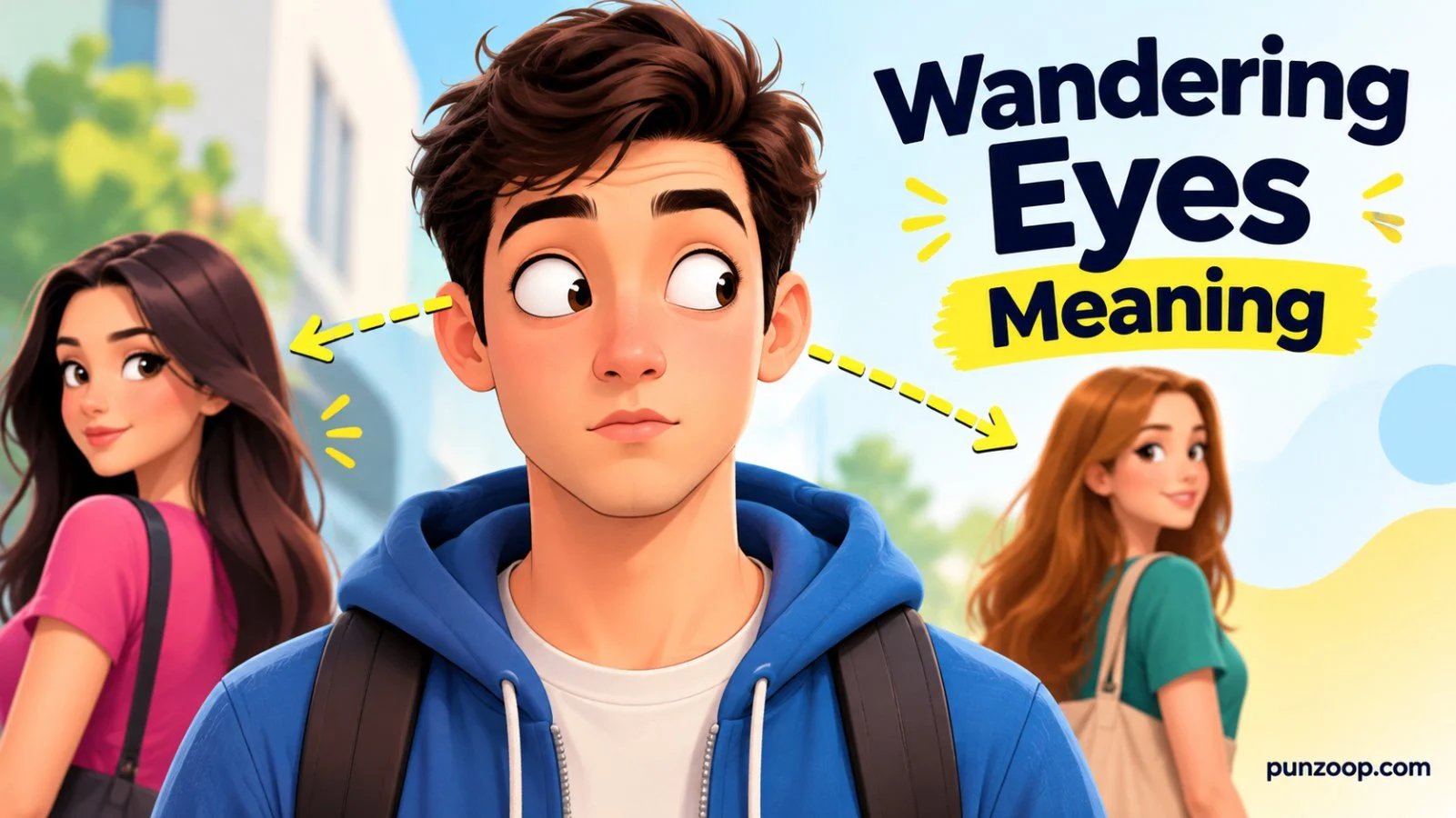
Have you ever caught your partner’s gaze drifting toward someone else across the room and felt that little knot form in your stomach? 💔 That uncomfortable moment is exactly why so many people search for the wandering eyes meaning in the first place. It’s a phrase we hear all the time in relationship talk, pop culture, and even old-school love songs, but very few of us actually stop to unpack what it truly signifies.
In simple terms, the wandering eyes meaning refers to a tendency — usually in a romantic partner — to visually notice, admire, or linger on other attractive people, even while in a committed relationship. It’s not always about cheating. Sometimes it’s biology, sometimes it’s habit, and sometimes, yes, it’s a genuine red flag. 🚩
This guide is going to walk you through everything: the origin of the phrase, the psychology behind it, real-life examples, how to tell the difference between harmless glancing and something more serious, and what you can actually do about it. Grab a cup of coffee ☕ let’s get into it.
What Does Wandering Eyes Mean? (The Simple Definition) 📖
At its core, the wandering eyes meaning boils down to this: a person whose attention (specifically their gaze) frequently shifts toward other people they find physically attractive, instead of staying focused on their partner or the person they’re with.
Think of it like this — you’re at a restaurant with your significant other, and their eyes keep drifting to the table behind you every time someone attractive walks by. That’s the behavior people are describing when they use this phrase. It can happen in person, on social media, or even during a simple conversation.
“Wandering eyes don’t always mean a wandering heart, but ignoring the pattern rarely helps a relationship either.” — Common relationship counseling wisdom
The phrase is often used interchangeably with terms like roving eye syndrome, “eye cheating,” or “visual flirting.” While none of these are official clinical terms, they all point toward the same core idea: noticing eyes that don’t stay put. 👁️
The Origin of the Phrase “Wandering Eyes” 🕰️
Understanding the wandering eyes meaning gets a lot easier once you know where the phrase came from. The word “wander” itself comes from Old English wandrian, meaning to move about without a fixed course or purpose. Pair that with “eyes,” and you get a vivid image: eyes that roam freely, without staying anchored to one place — or one person.
The expression became especially popular in relationship and dating culture throughout the 20th century, often showing up in song lyrics, movie dialogue, and advice columns. It captured something people had always noticed but never quite had the perfect words for — that subtle, sometimes uncomfortable behavior of a partner’s gaze drifting elsewhere.
Today, the phrase has found a second life online, with millions of people typing “what does wandering eyes mean” into search engines every single month, trying to make sense of something they’ve observed in their own relationships. 💻
Wandering Eyes Meaning in Relationships: Is It Normal? 💑
Here’s where things get nuanced. Not every instance of a wandering eye is a crisis. Humans are visually wired creatures — our brains are naturally drawn to novelty, symmetry, and attractiveness. This is simply part of how human perception works, and it doesn’t automatically mean disloyalty.
However, context matters enormously. There’s a real difference between:
- 👀 A quick, involuntary glance — natural and fleeting
- 😍 A lingering, obvious stare — intentional and noticeable
- 💬 Actively engaging with someone else while ignoring your partner — a deeper issue
The wandering eyes meaning shifts dramatically depending on which of these categories the behavior falls into. A momentary glance is human nature. A repeated pattern of lingering, flirtatious staring — especially paired with dismissive behavior toward your partner — tells a very different story.
Table: Harmless Glancing vs. Concerning Wandering Eyes
| Behavior | Harmless Glancing 🙂 | Concerning Wandering Eyes 🚩 |
| Duration | A second or two | Prolonged staring |
| Frequency | Occasional | Constant, in nearly every setting |
| Awareness | Barely notices they did it | Seems deliberate or unbothered when caught |
| Follow-up Behavior | Returns full attention to partner | Continues engaging, texting, or flirting |
| Partner’s Feelings | Mildly noticed, not upsetting | Repeated hurt, insecurity, distrust |
This table alone can help you gauge where your own situation lands. If most boxes fall under “harmless glancing,” there’s likely nothing to panic about. If you’re consistently checking boxes on the right, it’s worth a deeper conversation. 🗣️
The Psychology Behind Wandering Eyes 🧠
To truly grasp the wandering eyes meaning, we need to step into psychology for a moment. Researchers who study attraction and attention have found that visual scanning for attractive faces is an automatic cognitive process — it happens in milliseconds, often before a person consciously registers it.
This is sometimes called “mate-search behavior,” and evolutionary psychologists suggest it’s a leftover survival mechanism. Our ancestors’ brains were wired to notice potential partners as a way of ensuring genetic continuation, even when they were already paired off. In other words, your brain doesn’t fully “turn off” its scanning function just because you’re in a relationship.
That said, awareness and self-control separate a healthy adult from someone whose wandering eyes cross into disrespectful territory. Noticing is natural; dwelling, commenting, or acting on it is a choice.
Common Psychological Triggers
- 🎯 Novelty-seeking personality traits — some people are simply more stimulated by new experiences and faces
- 💔 Insecurity or low self-esteem — seeking validation from external attention
- 😴 Relationship boredom — waning excitement can heighten outward attraction
- 📱 Social media conditioning — constant exposure to curated, idealized images
- 🧬 Personality type — extroverted, highly social individuals may display more visible wandering
Signs of Wandering Eyes You Shouldn’t Ignore 🚨
If you’re trying to figure out whether what you’re witnessing fits the wandering eyes meaning in a worrying sense, here are some patterns worth paying attention to:
- Their gaze lingers noticeably longer than a glance when someone attractive walks by 👁️
- They get defensive or dismissive when you gently mention it
- Their body language shifts — leaning in, adjusting posture, straightening up around others
- It happens even during intimate moments with you, like dinner dates or conversations
- They compliment strangers’ appearance excessively or unprompted
- Their eyes track people as they walk away, not just as they pass
One or two of these on their own might not mean much. But when several appear together and repeat over time, the wandering eyes meaning starts to lean toward something that deserves an honest conversation rather than silent resentment.
Wandering Eyes vs. Cheating: Where’s the Line? ⚖️
This is probably the single biggest question wrapped up in the wandering eyes meaning debate: does it count as cheating?
Most relationship experts agree that looking, by itself, is not infidelity. Cheating typically involves intention, secrecy, and emotional or physical betrayal. Wandering eyes, on their own, usually don’t meet that bar.
However, wandering eyes can become a gateway behavior. If left unchecked, admiring glances can evolve into flirtation, then secret conversations, then emotional affairs, and eventually physical ones. This is why many couples choose to address the behavior early, before it has a chance to snowball. 🌨️
“It’s not the glance that breaks trust — it’s what a person does with that glance, and how honest they are about it afterward.”
Quick Comparison
| Wandering Eyes | Cheating |
| Visual attention only | Emotional or physical involvement |
| Often unconscious or brief | Usually deliberate and hidden |
| No secrecy needed | Involves lying or concealment |
| Doesn’t require action | Involves crossing a physical/emotional boundary |
Why Do Some People Have More Wandering Eyes Than Others? 🔍
Not everyone experiences the same intensity of wandering attention, and understanding why can add real depth to the wandering eyes meaning conversation. Several factors play a role:
- Personality traits — People high in openness to new experiences tend to notice more visual stimuli overall
- Attachment style — Those with anxious or avoidant attachment styles may seek external validation more frequently
- Relationship satisfaction — Couples in emotionally fulfilling relationships often report fewer wandering-eye incidents
- Cultural upbringing — Some cultures normalize open admiration of attractiveness more than others
- Past relationship trauma — Prior heartbreak can sometimes manifest as guarded or restless behavior
None of these factors excuse hurtful behavior, but they do help explain why the wandering eyes meaning isn’t a one-size-fits-all label. Every relationship carries its own context. 🧩
How to Talk to Your Partner About Wandering Eyes 💬
If you’ve noticed a pattern and it’s bothering you, communication is your best tool. Here’s a simple, respectful approach:
Step-by-Step Conversation Guide
- 🕊️ Choose a calm moment — never bring it up mid-argument
- 🗣️ Use “I” statements — say “I feel insecure when…” instead of “You always stare at…”
- 👂 Listen without interrupting — give them space to explain their side
- 🎯 Be specific — vague accusations lead to vague, unhelpful responses
- 🤝 Agree on boundaries together — mutual respect works better than ultimatums
Avoiding the topic altogether often makes resentment build quietly in the background, while overreacting can push a partner into defensiveness. The healthiest path sits right in the middle — direct, calm, and kind.
How to Handle It If You’re the One With Wandering Eyes 🪞
Sometimes the person searching for the wandering eyes meaning isn’t worried about their partner — they’re worried about themselves. If you’ve realized your own eyes tend to drift more than you’d like, here’s how to work on it:
- Acknowledge it honestly — denial only delays growth
- Reflect on the “why” — boredom, habit, insecurity, or something else?
- Practice mindful redirection — gently bring your focus back to the present moment
- Invest more in your relationship — novelty at home reduces the pull of novelty elsewhere
- Consider counseling — a neutral third party can help uncover deeper patterns
Self-awareness is genuinely the biggest turning point here. Recognizing a pattern is always the first step toward changing it. 🌱
Wandering Eyes in Pop Culture and Everyday Language 🎬
The phrase shows up everywhere — song lyrics, movie scripts, magazine advice columns, and everyday gossip between friends. It’s become shorthand for a very specific, very relatable feeling: catching someone’s attention drift somewhere it “shouldn’t.”
You’ll often hear variations like:
- “He’s got a wandering eye.” 👁️
- “She can’t help but people-watch, even on dates.”
- “His eyes wander more than his feet ever will.”
These casual phrases show just how deeply this concept has embedded itself into how we talk about relationships, trust, and attraction.
Wandering Eyes and Long-Term Relationship Health 💞
Long-term studies on relationship satisfaction consistently point to one theme: couples who maintain open communication and emotional intimacy report far fewer conflicts over wandering attention. When partners feel secure, appreciated, and desired at home, external glances tend to carry far less emotional weight.
On the flip side, unresolved wandering-eye tension can quietly erode trust over months or years, even if nothing “technically” happens. This slow erosion is often more damaging than a single dramatic incident, because it builds in silence. 🕯️
Ways to Strengthen Trust Over Time
- 💌 Prioritize regular quality time together
- 🎉 Keep novelty alive through shared new experiences
- 🙏 Practice gratitude and verbal appreciation daily
- 🔐 Maintain transparency about feelings, not just actions
- 🧑⚕️ Seek couples counseling proactively, not just in crisis
Common Myths About Wandering Eyes ❌
Let’s clear up a few misconceptions that often confuse the real wandering eyes meaning:
- Myth: “Wandering eyes always mean someone will cheat.”
Reality: Most people who notice attractive strangers never act on it. - Myth: “Only men have wandering eyes.”
Reality: This behavior appears across all genders equally. - Myth: “If you truly love someone, you’ll never notice anyone else.”
Reality: Noticing is biological; commitment is a choice. - Myth: “Ignoring it is the mature response.”
Reality: Healthy communication, not silence, resolves discomfort.
FAQs:
1. What does wandering eyes mean in a relationship?
The wandering eyes meaning in a relationship context describes a partner whose attention frequently drifts toward other attractive people, whether through glancing, staring, or lingering focus, instead of staying present with their partner.
2. Is having wandering eyes the same as cheating?
No. Wandering eyes typically involve visual attention alone, while cheating involves emotional or physical betrayal, secrecy, and intent. However, unchecked wandering eyes can sometimes lead toward more serious boundary issues over time.
3. Can wandering eyes be fixed?
Yes. With self-awareness, honest communication, and intentional effort to strengthen the relationship, most people can reduce this behavior significantly, especially when it stems from habit or insecurity rather than deeper dissatisfaction.
4. Is it normal to notice other attractive people while in a relationship?
Completely normal. Human brains are naturally wired to notice attractiveness. What matters is how a person manages that noticing — a quick glance is very different from repeated, obvious staring.
5. How do I tell my partner their wandering eyes bother me?
Choose a calm moment, use “I feel” language instead of blame, be specific about what you’ve noticed, and invite an open conversation rather than issuing accusations or ultimatums.
Final Thoughts:
At the end of the day, the wandering eyes meaning isn’t as black-and-white as it first appears. It sits somewhere between human biology, personal habits, relationship health, and individual choices. A glance isn’t automatically a betrayal, but a consistent pattern of disrespect shouldn’t be brushed aside either.
The healthiest relationships aren’t the ones where nobody ever notices anyone else they’re the ones built on enough trust and communication that a stray glance never has the power to shake the foundation. 💪❤️
If this article helped clear things up for you, take a moment to reflect on your own relationship dynamics with kindness, not judgment. Understanding the wandering eyes meaning is really about understanding human nature and giving both yourself and your partner grace as you navigate it together.